Sunday, August 17, 2008

Making a Splash

With swimming now on virtually every television viewer's mind, questions are popping up left and right over athlete's underwater wardrobes. Questions like, do those new Speedo swimsuits really make a difference? And what's the point of wearing a swim cap if you hardly have any hair, anyway?


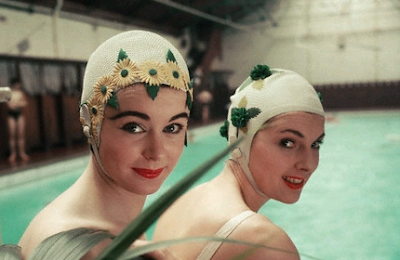
"Our new swim caps double as gardens!" Corbis.com.

Swim caps weren't always designed with competition being the main concern - in fact, there was a time when every swimmer wore one, regardless of how intense their swim would be. For a significant period of time, many pools required the caps, only relaxing on the rules about thirty years ago.

Women wore swim caps for one particular reason above all: Their hair, of course! Why, can you imagine the effects of chlorine on those lovely locks? Neither could they, so every time they went out for a swim, their caps came along with them.


Today's athletes are equipped with personalized swim caps. GettyImages.com.

And we're not talking ordinary swim caps, either. After all, if you had to wear one, why not make it somewhat pleasant? During the 1950s and 1960s, colorful florals were all the rage, with some especially elaborate designs costing up to $50 in today's money. Expensive, but keeping hair healthy and dry seemed to justify the cost.

Now, the question that really matters: Think Michael Phelps would wear one?
Read more...

Friday, August 15, 2008

The Bee's Knees

How often do pesky insects inspire trendy hairdos? Rarely, which is perhaps the reason behind the massive popularity of the buzzworthy beehive back in its heyday.


"Hello, you've reached 1-800-BEEHIVE." Corbis.com.

Although now often the butt of jokes, back in the sixties women took their beehives seriously, spending hours perfecting the heavily teased updo. Some chose to visit the salon for the perfect hive, but either way it involved liberal use of hair spray, rollers, and backcombing.

By the mid 1960s, the buzz over beehives could be heard everywhere, and the hairstyle reached new extremes. Using hair spray by the can and dozens of bobby pins, women gave real beehives a run for their money.


The advertisements for Chanel Paris-London 2008 featured updated beehives. TheFashionSpot.com.

As most trends go, the beehive craze gradually faded with the increasing regard for the 1970's less demanding styles. In recent years, however, watered-down versions have been spotted on runways and on stars. Looks like this is one hairstyle that hasn't buzzed off just yet!
Read more...

Wednesday, August 13, 2008

Keep On The Sunny Side

What would summer be without a dark, rich sun tan? For many cultures, few things come close to the popularity of tanning on the beach, and once warm weather hits, beachgoers everywhere hit the sandy slopes to work on their own tan.


"Maybe it's just this highly saturated photo, but your tan looks great!" Corbis.com.

With "build-a-tan" lotions of every shade and tanning booths open in the dead of winter, it seems impossible to imagine a time when sunbathing wasn't the norm. But would you believe that it was only a little over 60 years ago?

The story of Coco Chanel's accidental burn while on vacation that caused a sudden sensation in the 1920s is a famously told tale, and, while very true, this crispy trend didn't make its full appearance until the mid 1940s.

Combining 1946's controversial bikini with the look of bronzed skin, fashion magazines and Hollywood stars promoted the trend to its fullest extent, and fashionistas quickly took notice. With the help of the recently introduced tanning oil and their new skimpy bathing suits, a creamy tan was suddenly very easy to achieve.


In this Gucci advertisement, the intense tan takes center stage. HerFamedGoodLooks.com.

By the 1960s, when groups like The Beach Boys performed in their perfect California tans and crooned of sunny weather, tanning had surpassed being a mere fad and had become a way of life for many.

And even now, despite frequent warnings of the effects from too much sun exposure, flaunting an even tan is still just as chic as it was in the 1940s. Just don't forget your cat eye sunglasses!
Read more...

Saturday, August 9, 2008

A Trend That Raised Some Brows

Women in the roaring 1920s were no strangers to pain. Their meticulous beauty methods - which included using vacuum cleaners as hair dryers, and makeup made from messy wax - for achieving the perfect curls and picturesque makeup involved tactics most would now consider forms of torture.


"You don't get it, this is my serious face!" ViewImages.com.

With all the trouble they endured to get the popular flapper look, it should come as no surprise that women decided to fashion their eyebrows into the famous thin, clownlike shape. Perhaps they were making an attempt to express their true, remorseful feelings over how much effort they placed into creating the perfect face.

Or, more likely the case, they were simply following in the footsteps of celebrities like Greta Garbo and Louise Brooks.

In typical 1920s manner, the desired look wasn't easy to mimic. Women had no choice but to go to town with tweezers, often plucking until no trace of natural brows were left. Tweezers were then replaced with a stick of potentially lead-contaminated kohl eyeliner, which helped complete the illusion of dramatically high eyebrows.

The finished look, though leaving a permanent look of surprise on the wearer's face, was a welcomed change for those tired of the full, simple eyebrows that had reigned supreme for years.


The makeup for John Galliano's Fall 2007 collection was inspired by the 1920s. TheFashionSpot.com.

Painfully thin eyebrows proved to be all the rage well into the 1930s, but by the next decade fell out of fashion for full, well maintained arches. In the current era, some daring individuals have taken a note from flappers by shaving or plucking their eyebrows off completely, but this has yet to resonate with the fashion world as it did in the early 20th century.

And, considering the lengthy grow-out period for eyebrows, perhaps this is for the better.
Read more...

Thursday, August 7, 2008

Calling All Gibson Girls

Waists so tiny they could throw Barbie into a fit of jealousy, curled hair piled taller than one's head, and corsets so tight and constricting that women were forced to permanently adjust their posture - it's no wonder modern fashion has yet to tackle the Gibson Girl look in its entirety.


"I'm sorry, I can't suck in my stomach any more!" ViewImages.com.

Named after the creator, illustrator Charles Dana Gibson, the Gibson Girl was known as a beauty icon for women in the 1890s and early 1900s. Men loved her unbelievably perfect hourglass figure and fashionable bouffant, and women gradually learned to love it.

Eventually, after years of waddling in uncomfortable corsets, the Gibson Girl was no longer seen as the ideal woman. World War I had begun, and suddenly her high hopes and model figure felt outdated and meaningless in the midst of chaos. Women decided, in a reflection of the somber times, to ditch their corsets and extravagant gowns for narrow, shorter dresses and tailored coats.


For his Spring 2007 collection, designer Alexander McQueen created a toned down Gibson Girl. Style.com.

These days, corsets are rarely worn outside of costumes, and even then, they hardly come close to the extreme designs famous Gibson Girls like Camille Clifford and Alice Roosevelt donned, and rightfully so. Brings new meaning to the phrase, 'suffer for fashion,' doesn't it?

How to get the Gibson Girl look:
- Style your hair into a bouffant (Guide to the 1960s bouffant)
- Wear a form fitting gown with a nipped in waist and train (Golden Dot Mermaid Dress by Jovani, $400)
- Corset is optional!
Read more...